If you are considering dental implants, this article explains what they are, why many patients choose ceramic dental implants as a metal-free option, and what to expect from evaluation through recovery. You’ll learn who is a good candidate, the main implant types and restorations, typical costs and financing, and how a biologic periodontist can improve outcomes for ceramic dental implants. Practical next steps are included so you can move forward with confidence.
What Are Dental Implants And Why Choose Ceramic Dental Implants?
Dental implants are artificial tooth roots placed in the jaw to support crowns, bridges, or full-arch teeth. When people refer to dental implants near Bloomfield Hills, MI, they often mean modern options that restore chewing, speech, and appearance. Ceramic dental implants (zirconia) are a metal-free alternative that many patients choose for biological reasons.
Ceramic dental implants offer several benefits:
- Natural esthetics — white material that blends with teeth and gum tissue.
- Lower metal exposure — no titanium or other metals introduced to the body.
- Good tissue integration — zirconia bonds well to soft tissue and resists bacterial colonization.
- Long-term health considerations — preferred by patients seeking a biologic or metal-free approach.
Am I A Candidate For Dental Implants In Bloomfield Hills, MI (Ceramic Dental Implants)?
General Health And Oral Health Factors
Most adults can be candidates for dental implants in Bloomfield Hills, MI when overall health and oral health are stable. Key factors include:
- Age — implants are common for adults; growth must be complete for younger patients.
- Smoking — tobacco reduces healing and implant success; quitting improves outcomes.
- Chronic conditions — uncontrolled diabetes or certain immune disorders may require medical clearance and careful planning.
- Gum health — active periodontal disease must be treated before implant placement.
Bone And Gum Requirements
Successful placement depends on sufficient jawbone volume and healthy soft tissue. Bone loss, thin ridge shape, or active gum disease may require staged care like bone grafting or ridge augmentation. In some cases a sinus lift or delayed placement is recommended rather than immediate implant placement to ensure long-term stability for ceramic dental implants.
Role Of Biological Periodontistry
Biologic periodontistry improves candidacy and outcomes for ceramic dental implants by focusing on healing and infection control. Techniques commonly used include ozone gum therapy to reduce bacteria, laser periodontal surgery for precise tissue management, and PRF (platelet-rich fibrin) to accelerate bone and soft-tissue healing. These protocols help create a healthier environment for implant integration and reduce complication risk.
Types Of Ceramic Dental Implants And Common Restorations
Ceramic dental implants come in several formats to meet different needs:
- Single-tooth zirconia implants with a ceramic implant crown for isolated missing teeth.
- Implant-supported bridges and partials that replace several adjacent teeth without removable dentures.
- Full-arch solutions — systems like SmartFix® or TeethXpress® can be used with ceramic options to support immediate-load prosthetics when conditions allow.
Immediate placement and loading are possible for some patients, but a staged approach with bone grafting or sinus lift is preferred when bone volume or infection control requires extra healing time.
The Dental Implant Process Near Bloomfield Hills, MI — Planning, Surgery, And Recovery For Ceramic Dental Implants
Advanced Diagnostics And Planning
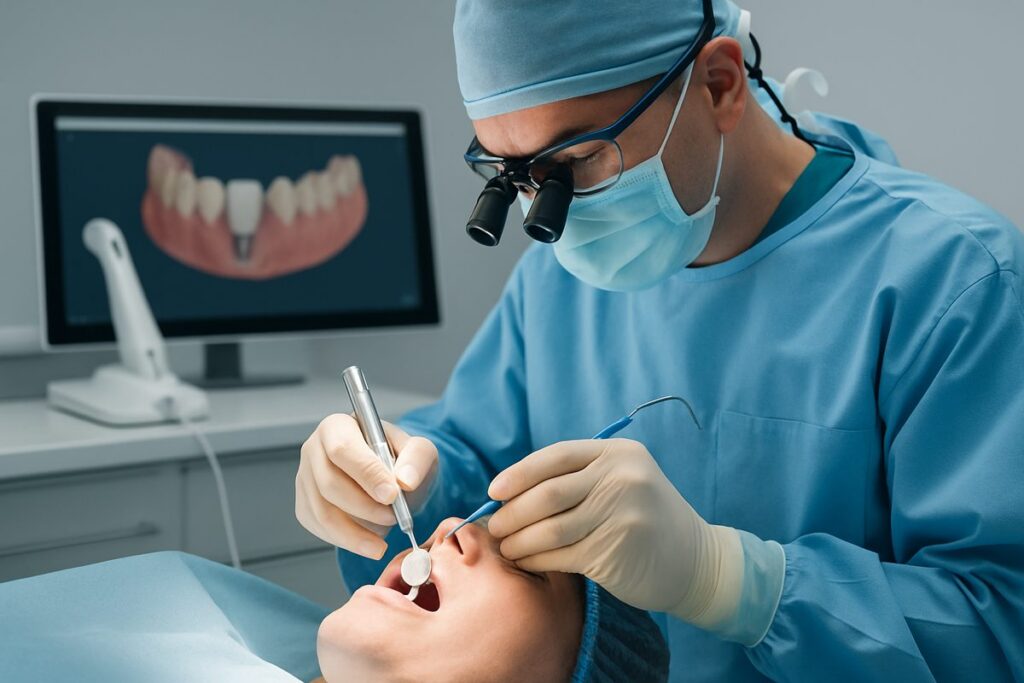
Planning for dental implants in Bloomfield Hills, MI typically uses CBCT 3D imaging and digital intraoral scans. These tools let the team map bone anatomy, plan implant size and angulation, and produce surgical guides for precise ceramic dental implant placement.
Surgical & Biologic Protocols
Modern implant surgery favors minimally invasive techniques. For ceramic dental implants this often includes laser-assisted soft tissue management, ozone sterilization of the surgical site, and PRF placed around the implant to boost healing. These biologic protocols reduce inflammation and support faster integration.
Recovery Timeline And Follow-Up
After ceramic dental implant surgery, initial healing takes 1–2 weeks for soft tissue, while bone integration usually requires several months. Immediate temporary teeth may be provided in select cases. Follow-up visits monitor healing, manage any discomfort, and confirm successful integration before final restorations are placed. Watch for warning signs like persistent swelling, severe pain, or drainage and contact your provider if they occur.
Cost, Insurance, And Financing Options For Dental Implants In Bloomfield Hills, MI (Ceramic Dental Implants)
The cost of dental implants in Bloomfield Hills, MI varies by:
- Number of implants needed and the type of prosthetic (crown, bridge, full-arch).
- Need for bone grafting, sinus lift, or staged surgeries.
- Choice of implant system — ceramic (zirconia) implants can cost more than standard titanium systems.
- Use of advanced diagnostics and biologic protocols like PRF and ozone therapy.
Insurance often covers part of the restorative work but may limit benefits for implants. Many practices offer financing, in-house payment plans, or third-party medical/dental financing to spread costs. When comparing options, look at total value: experience of the provider, biologic protocols, technology used, and expected longevity of the restoration.
Why Choose A Biologic Periodontist For Ceramic Dental Implants And How To Get Started
A biologic periodontist brings specialist training in gum health, regenerative techniques, and metal-free implantology. This focus matters when choosing ceramic dental implants because soft-tissue management, infection control, and regenerative protocols directly affect long-term success. Biologic specialists commonly use CBCT-guided planning, lasers, ozone therapy, and PRF to create predictable, natural-looking outcomes.
Dr. Lauren Anderson, DDS, MS, leads Anderson Periodontal Wellness in Bloomfield Hills, MI, and focuses on ceramic implantology and biologic periodontal care. Her practice integrates CBCT imaging, laser periodontal surgery, ozone protocols, and PRF to support metal-free implant solutions and whole-body wellness.
Next Steps
To prepare for a consult for ceramic dental implants:
- Bring a list of medical conditions and current medications.
- Bring any recent dental X-rays or request CBCT imaging at the consult if needed.
- Expect a clinical exam, CBCT review, and a discussion of biologic protocols, timelines, and cost estimates.
Scheduling a consultation is the best way to get a personalized plan that matches your health goals and preferences for ceramic dental implants. A specialist can explain options, answer questions about metal-free choices, and guide you toward a safe, esthetic result.